You know the routine. Show up, grab the large bucket, and blast drivers until your hands ache. Forty-five minutes later, you walk off no better than when you arrived.
That’s not practice. That’s just hitting balls.
Whether you hit a driving range in San Diego every week or once a month, the difference between swinging and improving comes down to structure. A focused 45-60 minute session can do more for your game than three hours of aimless swinging. Here’s how to build one, from your first stretch to your last pressure shot.
Warm Up Before You Swing
The fastest way to waste a bucket is pulling driver on your first swing. Cold muscles produce loose swings, and loose swings groove bad habits. Your lower back will not thank you either.
Take five minutes before your first full swing:
- Stretch your shoulders, hips, and hamstrings. Golf puts rotational stress on all three.
- Hit 10-15 balls with a pitching wedge or 9-iron at half speed.
- Focus on tempo and clean contact, not distance.
- Work up through the bag gradually, adding speed as you loosen up.
A short warm-up protects your body, but it does something else too. It tells you this session has a purpose before the first real swing.
Practice with a Target, Not Just a Direction
Stand behind the hitting line at any range and watch for a few minutes. Most golfers aim at nothing. They pick a general direction, swing, and judge the result by feel.
Every ball you hit should have a specific target: a flag, a yardage sign, a patch of grass. Aim small, miss small. Picking the 150 sign beats aiming “out there somewhere” every single time, and switching targets every few swings keeps you from getting comfortable.
Better yet, simulate real situations. Tell yourself, “This is a 160-yard approach to a front pin on Oak Glen number 7,” then go through your full routine. Now you’re rehearsing golf instead of exercising.
Then keep score. Out of 10 shots at your target, how many land within a 10-yard circle? Track it mentally or in a notes app. When six out of 10 becomes eight out of 10, you’ll know the work is paying off.
Structure Your Bucket: The 40-30-30 Rule
Here’s a simple framework for the whole session. Split your bucket three ways:
- 40% mid-irons and wedges. These are your scoring clubs, and they deserve the biggest share of your practice.
- 30% woods and driver. Enough to groove your tee shots without turning the session into a long-drive contest.
- 30% short game. Chips, pitches, and the awkward in-between shots that decide your score.
Most golfers run this backward. Driver is fun, so it gets 70% of the bucket. But you’ll hit driver maybe 14 times in a round, while the shots that decide your score mostly happen from 100 yards and in. Give your practice time to the clubs that earn it.
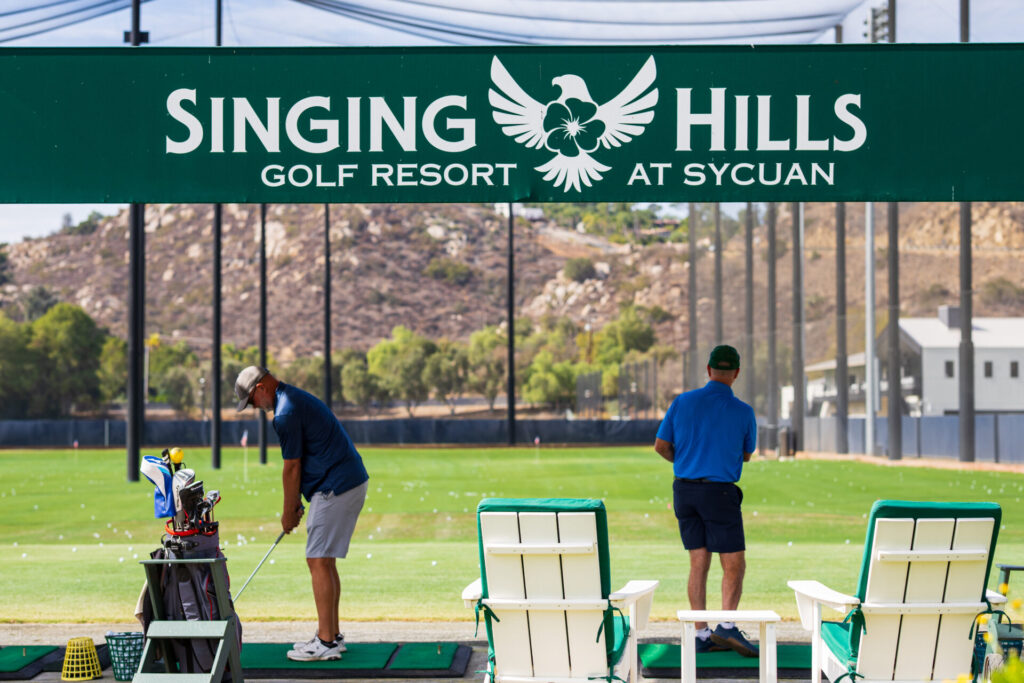
The short-game portion is where the facility matters. The driving range at Singing Hills Golf Club includes dedicated short game areas and private practice fairways, so you can work through the full 40-30-30 split in a single visit. If your usual range doesn’t have a short game area, chip to a towel in the backyard or spend 15 minutes on a practice green instead.

End Every Session with Pressure
Range balls are free of consequences, and that’s exactly the problem. On the course, every shot counts, so your last 10-15 balls should feel that way too.
Set a stake before you swing. Something like: “I need to hit three out of five within 15 yards of the 100-yard marker to win.” Miss, and you lose the session. It sounds silly until you feel your grip tighten on ball four. That’s the same nervous energy you fight over a putt that matters, and now you’re training it.
Prefer something closer to real golf? Play a virtual hole. Hit driver, decide where it would have landed, then pick the iron you’d need for the approach. Finish with the wedge shot you’d face after a decent miss. One imaginary hole teaches more course management than 20 identical 7-irons.
When to Get Help from a Pro
Range time reveals patterns, and patterns are information. If you’ve practiced weekly for a month and your miss hasn’t changed – same slice, same thin contact – more buckets won’t fix it. A good instructor can diagnose in 10 minutes what you’d spend months guessing at.
Think of it as a loop: the lesson gives you direction, and the range gives you repetition. Singing Hills’ golf lessons are taught on the range by PGA and LPGA professionals, including Director of Instruction Bob Madsen, a Southern California PGA Teacher of the Year. The Golf Academy also offers programs for women, juniors, and custom packages, and any instructor can build a practice plan around your specific goals.
Never taken a lesson before? Here’s what to expect at your first golf lesson.
Make Your Next Bucket Count
Warm up first, give every shot a target, split the bucket 40-30-30, and finish under pressure. That’s the whole system. It fits inside an hour, and it turns range time into real improvement.
The driving range at Singing Hills is open daily, with dedicated practice areas for your full swing, short game, and everything in between. Whether you’re warming up for a round on Willow Glen or working through a drill from your last lesson, we have the space and the instructors to help you get better. We think it’s the best driving range San Diego golfers will find, and we’d love the chance to prove it. Call (800) 457-5568 or visit us in the Dehesa Valley.
FAQs About Driving Range Practice in San Diego
How many balls should I hit at the driving range?
Quality beats quantity. A focused session of 50-75 balls with targets and a plan does more for your game than 150 balls hit mindlessly. Expect a purposeful session to take 45-60 minutes.
What clubs should I bring to the driving range?
Bring your full bag when you can, so you practice with the same clubs you’ll play on the course. At minimum, pack a wedge, a mid-iron, a hybrid or fairway wood, and your driver.
How often should I practice at the driving range?
Two to three sessions per week is ideal if you want to improve. Once a week will maintain your current level. Even 30 focused minutes counts, so don’t skip a session just because it has to be short.
Is the driving range good for beginners?
The range is the best place to start playing golf. There’s no pressure, no pace of play to worry about, and you can focus entirely on building your swing. Once you’re comfortable, a shorter layout like a par 3 course is the natural next step before a full 18.
Does Singing Hills have a short game practice area?
Yes. Singing Hills offers multiple short game areas and private practice fairways in addition to the full driving range, so you can practice chips, pitches, and full swings in one visit.